Research
PhD at Concordia (FRQNT-funded) on the Nested Dirichlet Distribution for interpretable hierarchical models. Ten peer-reviewed papers in IEEE, Springer and ICONIP venues; reviewer for NeurIPS, AAAI and ICONIP.
AI Engineer · Solutions Architect · Researcher · Educator
Hi, I’m Fares Alkhawaja.
I work where three worlds meet: research that creates new models, engineering and architecture that put AI into production, and teaching that brings the next generation with me.
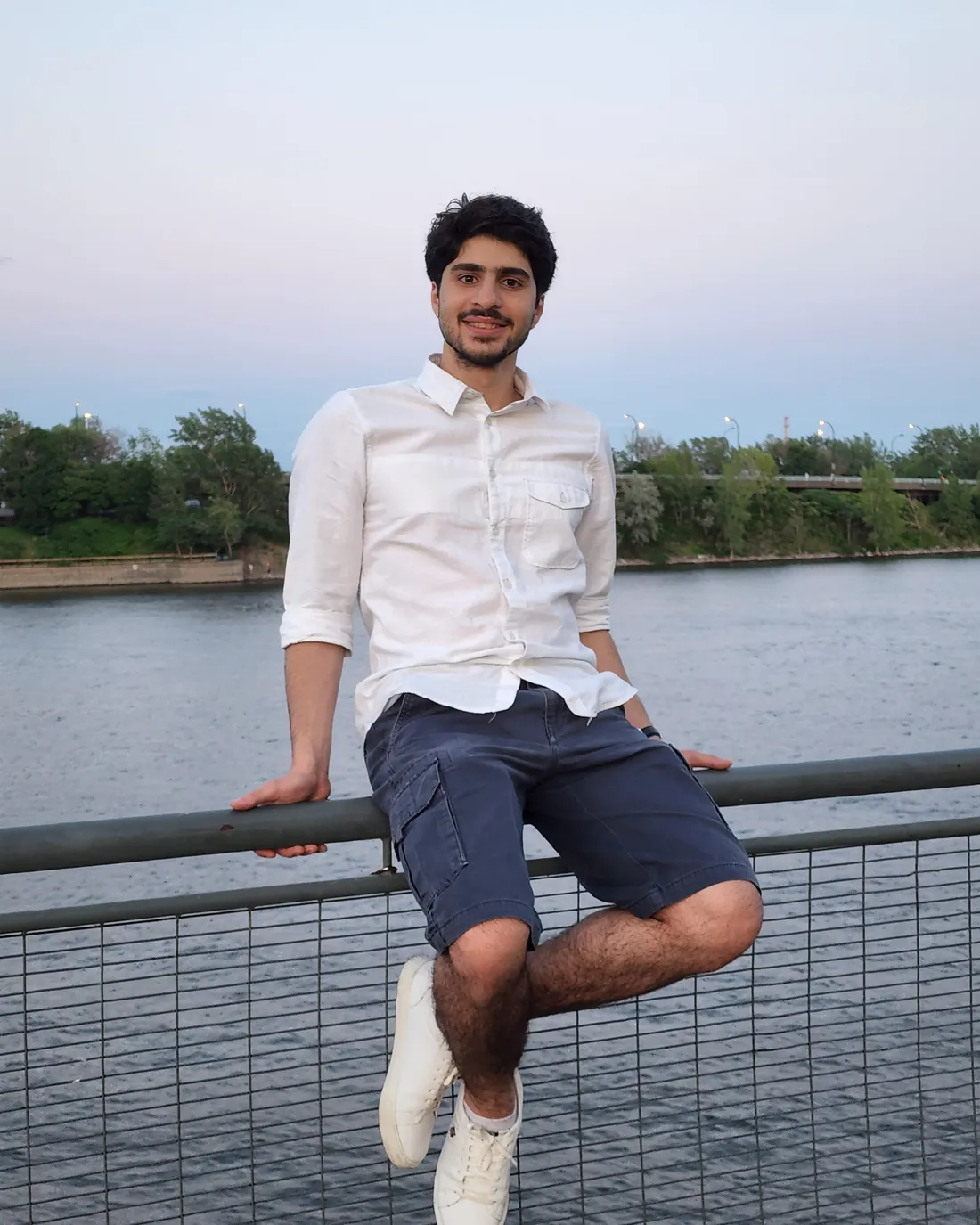
Who I am
Most people pick one lane. I work in three, and each one makes the others better. Research gives my engineering rigour and new methods; production keeps my research honest about what actually works at scale; teaching forces me to explain both clearly.
In practice, a model I formalize in a paper is one I can also architect on Azure, AWS or GCP, secure behind an API gateway, monitor in production, and teach in a lab the following week.
The path runs from IT and engineering support at Schlumberger, MetLife and the Ajman Government, through mechatronics and robotics research, to AI engineering and solution architecture at Desjardins and a computer-science classroom at Vanier College.
PhD at Concordia (FRQNT-funded) on the Nested Dirichlet Distribution for interpretable hierarchical models. Ten peer-reviewed papers in IEEE, Springer and ICONIP venues; reviewer for NeurIPS, AAAI and ICONIP.
AI engineering and solution architecture on Azure, AWS and GCP: agentic RAG and multi-agent systems, API gateways and secure AI environments, data pipelines, microservices, CI/CD, governance and IT operations.
Ten institutions, from robotics workshops for kids to MLOps, Kubernetes and neural-network labs at Vanier and LaSalle, college mathematics, and AI training for professionals.
By the numbers
Work experience
What drives me
My research centres on hierarchical probabilistic modelling with the Nested Dirichlet Distribution, extending into federated learning, sensor fusion and applied, agentic AI.
Peer-reviewed
Applied Artificial Intelligence, 40(1): 2731990 · 2026
IEEE Transactions on Human-Machine Systems · 2025
ICONIP, pp. 406–420 · 2024
37th International FLAIRS Conference · 2024
37th International FLAIRS Conference · 2024
Applied Intelligence (Springer), 53(21): 25232–25258 · 2023
Robotica, 41(6): 1689–1717 · 2023
IEEE Transactions on Vehicular Technology, 70(7): 6554–6566 · 2021
IEEE ASET · 2019
ISMA 2018 · 2018
Knowledge transfer
I love seeing students learn something new and grow with it. These are the places I have taught, from elementary robotics to graduate labs.
Data mining, wrangling and visualization, data structures and algorithms; Docker, Compose and Swarm, CI/CD, Kubernetes, Helm, Prometheus, Grafana, MLflow and GCP.
Generative AI, LLMs, prompt engineering and applied data science for professional learners.
Labs, tutorials, evaluation and office hours at the Gina Cody School (CIISE).
College and high-school mathematics with computational problem solving.
Coding, robotics and AI literacy workshops for elementary students.
Neural networks, responsible AI, data structures, DevOps and full-stack engineering.
Cybersecurity, AWS/Azure cloud, full-stack development; curriculum design, capstone mentoring and instructor orientation.
STEM capstones and competitions, including a mentored student with a disability who reached the Think Science 2021 finals.
Mechatronics and robotics labs; mentored FIRST Robotics (FRC) teams and took part in MBZIRC.
Peer tutoring in engineering courses as a top-ranked undergraduate.
Every concept is introduced with intuition first, mathematics second and a working implementation third, so students can explain what they build. Labs mirror real engineering work: version control, containers, CI/CD, monitoring and code review, not only notebooks.
Frequent, low-stakes practice with clear rubrics and timely feedback, combined with project-based evaluation. Students defend design choices, evaluate models honestly and document their work, in line with responsible-AI practice.
Multidisciplinary teams, live problem solving and industry case studies keep sessions active. Mentoring extends beyond class to competitions (FRC, MBZIRC, Think Science), capstones, internships and career preparation.
Courses are built backwards from production-grade outcomes and updated against industry practice and emerging AI technologies, from data wrangling and neural networks to Docker, Kubernetes, MLflow and cloud platforms.
Toolbox
End-to-end dashboards that consolidate multi-source data through APIs and scraping, with actionable insights.
Production multi-agent chatbot on AWS Bedrock, NestJS and React.
Azure OpenAI and Semantic Kernel Copilot actions in .NET.
Extracts mathematical equations from images into presentation slides.
Core PhD contribution: the Nested Dirichlet Distribution in mixture models.
NLP model for intent recognition and semantic similarity.
End-to-end conversational AI deployed through Azure REST APIs.
Autonomous landing system for the Mohamed Bin Zayed International Robotics Challenge.
FOPID/PID control for thermoelectric battery cooling and motor speed.
Internal tools for process optimization and budget management.
Sensor-based haptic feedback wearable with speech recognition.
Early awarded projects: IEEE CDP 2015, Best Logic Design 2014, Think Science 2013.
Work with me
Algebra, calculus, linear algebra, probability and statistics, with a computational problem-solving angle.
Generative AI, LLMs, RAG, neural networks, data wrangling and visualization through hands-on labs.
Docker, CI/CD, Kubernetes, MLflow and cloud deployment on AWS, Azure and GCP.
Project scoping, modeling, experiments and paper writing in AI and machine learning.
Project-based coding, robotics and AI literacy, including FIRST Robotics mentoring.
Agentic RAG systems, retrieval benchmarking and cloud-native AI architecture.
Life in frames
Contact
Questions about a course, tutoring, research collaboration or an AI project? Send a message and I will reply as soon as I can.